Wedding Invitation Timeline: Save the Dates to Final Reminders
By Bejoined · · Updated · 6 min read
Quick answer
Save the dates go out 6 to 8 months before the wedding, invitations 6 to 8 weeks out (10 to 16 weeks for destination), and RSVPs come due about 4 weeks before. Chase silent guests the week after the deadline passes, and hand the caterer the final count by the date in your contract, usually 1 to 3 weeks out. Set the RSVP date by working backward from that contract date.
Who this is for
Couples who keep finding one more paper deadline. Save the dates have a window, invitations have a window, the RSVP date has rules, and somewhere behind all of it a catering contract has a final-count date that does not care about any of them. This article puts all six deadlines on one calendar, in the order you should set them, which is not the order they happen. Every number in it is current as of August 2026.
The six paper deadlines
Six dates run your wedding paper. Everything else in this article explains how to pick each one.
| Deadline | When | Who sets it |
|---|---|---|
| Save the dates | 6 to 8 months out; 8 to 12 destination | You |
| Invitation suite ordered | 8 to 10 weeks before the mail date | You |
| Invitations mailed | 6 to 8 weeks out; 10 to 16 destination | You |
| RSVP deadline | About 4 weeks out | You, working back from the caterer |
| Reminders and chasing | Week before the deadline, then the week after | You |
| Final count to the caterer | The date in the contract, commonly 1 to 3 weeks out | The caterer |
Here is the part that saves you a reprint: set the last date first. The caterer’s final-count deadline is the only one you do not control, so read the contract, then place the RSVP date in front of it, then let the invitation date follow. Couples who set these top to bottom end up chasing guests during the week the caterer wants a number.
Save the dates: the short version
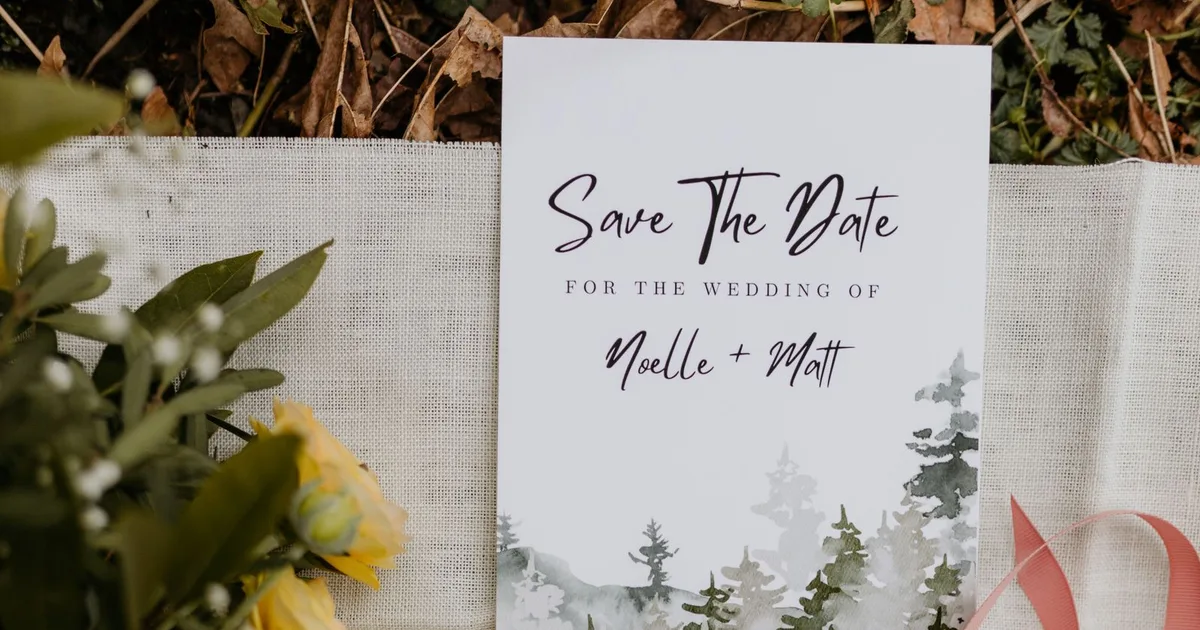
They go out 6 to 8 months before the wedding, 8 to 12 for a destination or holiday-weekend date, only after the venue contract is signed, and only to people you would put on the guest list today, because a save the date is a promise of an invitation. Under four months out, skip them and mail invitations early instead. The full decision, including what they cost, what goes on the card, and when digital is the right call, lives in the save the dates guide.
Invitations and the destination exception
The invitation window is the closest thing the industry has to consensus: mail 6 to 8 weeks before the wedding (Emily Post, Shutterfly). The honest disagreement is which end of the window is yours.
- Mail at 8 weeks when part of your list has to travel, when your date sits near a holiday, or when you want slack for a slow mail week.
- Mail at 6 weeks when the list is local and everyone got a save the date months ago. The card is confirming a date guests already hold.
- No save the dates went out? Stretch to 10 to 12 weeks (Shutterfly). The invitation is now doing both jobs, so it needs the longer runway.
The destination exception is real, and sources split on its size: Zola says to add a few weeks to the standard window, while Shutterfly says to mail 3 to 4 months out, with at least 12 weeks for a holiday-season date. Treat 10 to 16 weeks as the honest range and pick inside it based on how far your farthest guest flies.
Then set the order date from the mail date, not from the wedding. Give the suite 8 to 10 weeks between ordering and mailing for proofing, printing, and shipping, and no lane needs a rush fee. Mailing at 8 weeks means ordering around 16 weeks out, about 4 months. Mailing at 16 weeks for a destination wedding means ordering around 24 weeks out, about 5 to 6 months, right behind your save the dates. The common rule, order 3 to 4 months out, is the same math with the standard window already plugged in, which is why it comes up short the moment you mail early. The invitation buying guide prices the three ways to do that.
Setting the RSVP date that protects your caterer deadline
The RSVP deadline is not about your curiosity. It exists so that a final count reaches every per-person vendor on time, and the caterer’s contract sets that date, commonly 7 to 14 days before the wedding and sometimes 21 (Text My Wedding; Plan In Love puts the common window at 2 to 4 weeks). So build the date backward:
- Read the catering contract and write down the final-count date.
- Put the RSVP deadline at least a week before it, two if you can. That buffer is your chasing week, and you will use it.
- Check the result against the standard advice: about 4 weeks before the wedding (Zola says no later than 1 month; Shutterfly says 3 to 4 weeks). If your caterer wants the count 3 weeks out, the RSVP date moves to 4 or 5 weeks out, and the invitation mail date moves toward 8 weeks to match.
- For a destination wedding, move everything up: Shutterfly puts the destination RSVP deadline at 6 to 8 weeks before the wedding.
Print the deadline on the card, name every invited guest, and decide the plus-one policy before anything mails. The RSVP mistakes article covers the card itself; this timeline only cares that the date on it is the right one.
Reminders and website updates
Silence is normal. Plan for it instead of resenting it.
- One week before the RSVP deadline: send a reminder to everyone who has not answered (Joy). A group text or email is fine; the card in the mail was the formal ask, this is the practical one.
- The week after the deadline: start personal messages to the holdouts. Joy says a follow-up a week after the deadline; Zola allows one to two weeks. If your buffer before the caterer date is thin, use the shorter end. Calls and texts beat a second mass email here, because the silent guests already ignored one of those.
- The website carries the rest. Launch it alongside the save the dates, 6 to 8 months out (Joy), then update it in the final 1 to 2 months with the details guests actually text you about: timing, parking, dress code, and transportation. Day-of details belong there, not on the invitation, because the website can change after the paper is printed.
The worked example: a June 12 wedding, or yours
The table below starts as a worked example: a Saturday, June 12, 2027 wedding with a catering contract that wants the final count 10 days out. Enter your own date and contract terms and every deadline recalculates.
Your paper timeline
| October to December 2026 | Save the dates out, 6 to 8 months ahead |
| February 6 to 20, 2027 | Invitation suite ordered, 8 to 10 weeks before the mail date, no rush fees |
| April 17, 2027 | Invitations mailed, 8 weeks out |
| May 8, 2027 | Reminder to everyone unanswered, a week before the deadline |
| May 15, 2027 | RSVP deadline, 4 weeks out |
| May 16 to 22, 2027 | Chasing week: personal texts and calls to the silent |
| June 2, 2027 | Final count to the caterer, per the contract |
Windows: save the dates 6 to 8 months (8 to 12 destination), invitations 6 to 8 weeks (10 to 16 destination, 10 to 12 with no save the dates), the suite ordered 8 to 10 weeks before whichever mail date you land on, RSVP about 4 weeks out, and the final count from your contract. Your caterer's date wins every tie.
The calculator splits one of the six into two rows: the reminder and the chase get their own dates, because they are different jobs a week apart, and the table above folds them into a single line.
Whatever date you enter, notice the two-week-plus gap the calculator keeps between the RSVP deadline and the caterer date. That is not slack; that is the chasing week plus the seating chart, which only gets built once when it starts after the count is real. The same sequencing sits inside the 12-month planning timeline as two bullets; this page is those bullets with dates on them.
Mistakes to avoid
- Printing the RSVP date before reading the catering contract. The most expensive version of picking a date by feel. The contract wins; the card is just where you announce it.
- Setting the RSVP deadline inside the final-count window. A deadline 10 days out with a count due at 10 days leaves zero chasing days.
- Keeping the 6-week mail date after skipping save the dates. No save the date means the invitation needs 10 to 12 weeks, not 6.
- Mailing destination invitations on the local schedule. Guests booking flights need 10 to 16 weeks, and the RSVP date moves up with them.
- Having no chase plan. Some guests will not answer. Decide now who texts which holdouts in the week after the deadline, so the silence costs you nothing but the texts.
- Treating the website as set-and-forget. It launches with the save the dates and earns its keep in the last month, when it answers the questions the invitation cannot.
Related articles
Planning
Save the Dates: When to Send, What They Cost, When to Skip
When to send save the dates by wedding type, what paper and digital cost with 2026 postage, what goes on the card, and when skipping them is the right call.
· 7 min read
Read article
Timelines
12-Month Wedding Planning Timeline
A 12-month wedding planning timeline with real deadlines: what to book, decide, and pay month by month, from engagement to wedding day.
· 6 min read
Read article
Guests
Wedding RSVP Mistakes That Cause Problems Later
The RSVP mistakes that surface at the worst time: deadlines set too late, unnamed cards, plus-one ambiguity, and no plan for the guests who go silent.
· 5 min read
Read article